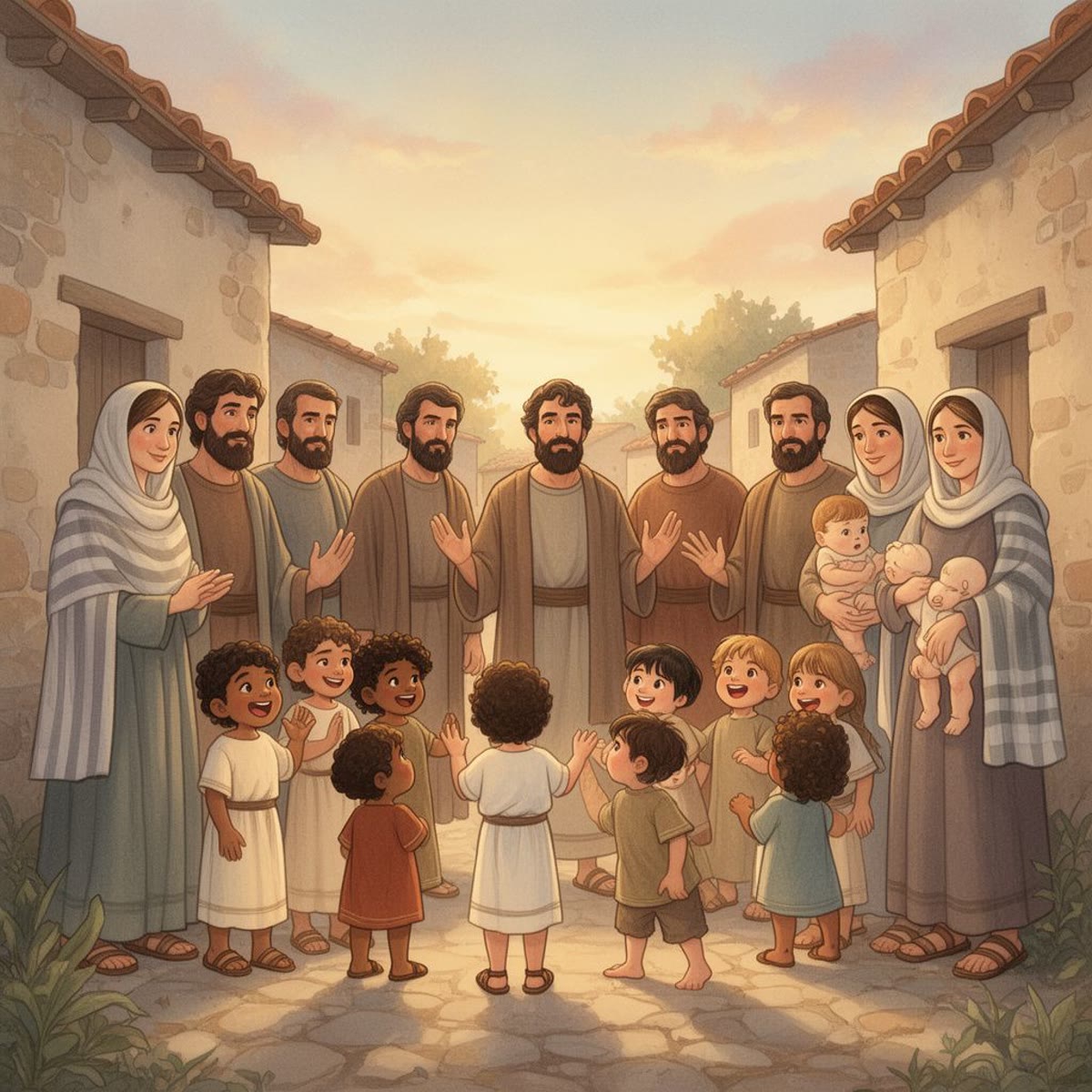
If you have a four-year-old, you already know that ten minutes can be a long time. It's long enough for a meltdown to start and end. It's long enough to negotiate socks. It is also, it turns out, long enough to change how a child's brain handles language — and how they start to understand who God is.
That's not an exaggeration. It's just what reading aloud does, and it does it whether or not the child is sitting still, looking at the pictures, or asking the same question for the fourth time.
What's actually happening when you read aloud
A four-year-old's spoken vocabulary is nowhere near their listening vocabulary. They can understand words in a story — "created," "formless," "blessed" — long before they'd use those words themselves. Read-aloud time is one of the few places those bigger words show up in a context a small child can follow, because you're right there to explain, point, and repeat.
It also teaches story structure before a child can read a single word: that things happen in order, that there's a beginning and an end, that a character wants something and either gets it or doesn't. That structure is the scaffolding kids later use to read on their own — and it's the same scaffolding they'll use to make sense of the Bible as a whole, not just isolated verses.
And then there's the relational part, which matters just as much as the cognitive part. A four-year-old sitting in your lap or leaning against your side while you read about God making the world is learning, underneath the words, that big and important things get talked about together. That faith isn't a subject, it's a shared activity.
A routine that actually survives real life
The routine doesn't need to be elaborate. In fact, elaborate is usually what kills it by week two. What works is small and repeatable:
- Same time, same place. Right after bath, or right before lights out. The predictability does more work than the content does.
- One short story, not a chapter. Ten minutes is plenty. If your child wants more, that's a bonus, not the goal.
- Let them interrupt. A four-year-old asking "why did God make the fish first" mid-page is not a distraction from the reading. It is the reading working.
- Reread on purpose. Kids this age ask for the same story again because repetition is how they learn it, not because they're stalling (though sometimes they are also stalling).
What to notice, week by week
You won't see progress like a chart. You'll see it sideways. A child starts narrating a picture before you turn the page. They correct you if you skip a line. They use a word from the story — "good," "made," "rest" — in an unrelated sentence three days later. They ask a question that shows they're building a timeline in their head: "was that before or after the animals?"
Those are the markers. Not whether they can recite the story back to you, and not whether they sit still for it. Just: are they reaching for the words and the ideas on their own, outside of reading time. That reaching is the whole point.
It's also fine — expected, even — if some nights the ten minutes is mostly wiggling and half-attention. Read-aloud time compounds. It's not any single night doing the work, it's the pattern of showing up with the same book, the same voice, the same lap to climb into.
Want a story built for exactly this age and this kind of night? Try a free Fernbug story or browse the full library.